
How to Design a Wardrobe for Small Bedrooms in Singapore: A Technical Guide to Ergonomic Storage
In Singapore’s high-density living environment, wardrobe design in BTO flats and condominiums is often the most under-optimized element of the bedroom. Chronic clutter is rarely a result of poor habits; it is usually the consequence of fixed carpentry layouts that ignore ergonomic reach, apparel dimensions, and human movement patterns.
To create a truly functional bedroom, homeowners must move beyond surface aesthetics and adopt a data-driven approach to wardrobe planning—one that prioritizes vertical space efficiency and climate-appropriate materials.
📌 Key Takeaways (TL;DR)
- The 600mm Rule: Maintain at least 600mm of clearance between your bed and wardrobe for comfortable movement.
- Hang More, Fold Less: Boost storage capacity by up to 100% by replacing inefficient folding shelves with modular hanging rods.
- Climate Resilience: Precision metal wardrobes offer 0% moisture absorption, outperforming wood in Singapore’s high humidity.
- Ergonomic Zones: Place daily essentials in the "Power Zone" (650mm – 1850mm) to minimize physical strain.
The Primary Directive: Hanging Over Folding
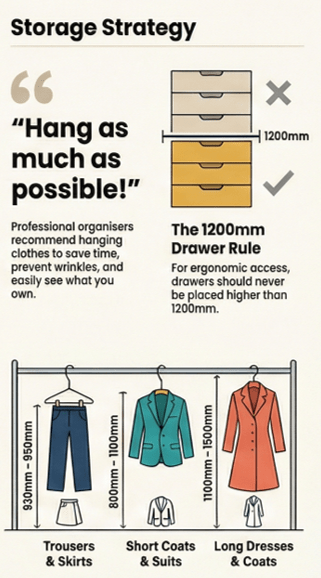
Professional wardrobe organizers and spatial engineers operate on one core principle: "Hang as much as possible." From a technical standpoint, hanging is the most efficient storage solution for urban dwellers. It preserves garment integrity, prevents wrinkles, and significantly reduces retrieval time. Traditional cabinet structures characterized by vertical rows of folding shelves are often inefficient; retrieving a single item often disrupts the entire stack.
By reconfiguring the internal architecture—removing redundant shelves and installing additional hanging rods—you can double your storage capacity. For instance, a typical 3-rod wardrobe might only accommodate 150 items; however, by re-engineering it into six hanging areas, the same physical footprint can accommodate upwards of 300 items.
Anthropometric Mapping: The Three Zones of Access
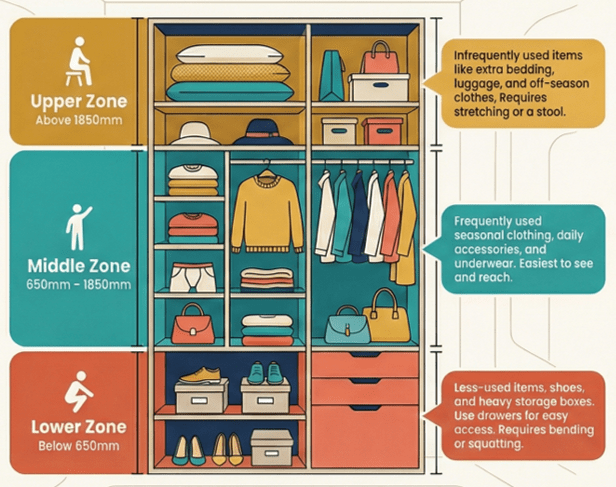
Effective wardrobe design for HDBs and Condos must be mapped against human height and movement. We categorize these into three distinct vertical zones:
| Access Zone | Height Range | Best Use Cases |
|---|---|---|
| The Power Zone | 650mm – 1850mm | Daily wear, seasonal clothing, and high-frequency handbags. |
| The Lower Zone | Below 650mm | Out-of-season clothes, shoes, or items in deep drawers. |
| The Upper Zone | Above 1850mm | Extra bedding, travel bags, and infrequently used suitcases. |
Ergonomic Note: Drawers should never be positioned above the 1200mm mark. Placing drawers higher makes them difficult to observe and inconvenient to access, violating the fundamental rules of ergonomic reach.
Technical Specifications for Apparel Storage
To maximize vertical clearance, a bespoke wardrobe must be compartmentalized based on the specific dimensions of your inventory:
- Formal Trousers & Skirts: Require a dedicated height clearance of 600mm to 800mm.
- Dresses: Long dresses require 1100mm to 1400mm; short dresses need 700mm to 900mm.
- Suits & Coats: Suits require 800mm to 900mm width, while heavy coats necessitate 1000mm to 1100mm.
- Shirts & Blouses: Generally require 800mm to 1100mm of vertical space.
Spatial Engineering and Layout Efficiency
In compact Singaporean bedrooms, the clearance between the wardrobe and the bed is a non-negotiable metric for movement.
1. The 600mm Rule
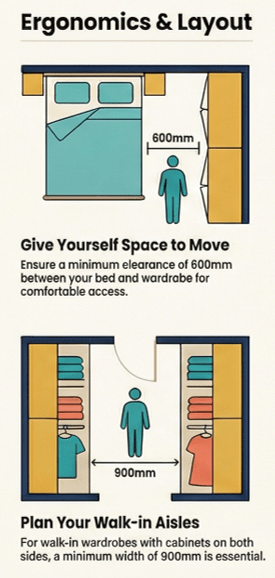
A minimum clearance of 600mm is required to ensure enough standing room to comfortably open swing doors. If your floor plan is tighter, sliding doors are the recommended technical alternative.
2. Movement Corridors
For walk-in closets, an aisle width of 900mm is recommended. In constrained layouts, 800mm is acceptable if visually extended by an adjacent mirror.
3. Corner Optimization
"Dead corners" in L-shaped wardrobes should be fitted with continuous hanging rods to ensure these areas do not become inaccessible "black holes."
Structural Integrity and Climate Adaptability
In traditional carpentry, fixed vertical panels are load-bearing and cannot be moved, which limits future reconfiguration. Modern modular wardrobe systems solve this by using precision metal frameworks with pre-drilled adjustment holes at 25mm–50mm intervals.
Furthermore, precision metal wardrobes are technically superior in the Singaporean climate. According to the BCA Material Testing Report 2024, aluminum-based structures show 0% moisture absorption, whereas traditional wood-based cabinetry can uptake 8–12% moisture, leading to warping and mold growth within 6–8 months in high-humidity environments.

Why This Matters for Your Home
At HausBedroom, these engineering principles are not theoretical—they are built directly into our modular wardrobe systems.
HausFlex is designed for homeowners who want a wall-mounted, precision-engineered solution that maximizes vertical space while remaining fully reconfigurable. Its metal framework allows shelf heights, hanging rods, and drawers to be adjusted in fine increments as your storage needs change—without hacking or rebuilding. This makes it ideal for BTO bedrooms where layouts evolve over time.
HausPole, on the other hand, applies the same ergonomic and anthropometric logic in a lighter, pole-based system—perfect for open-concept wardrobes, flexible bedrooms, or homeowners who prefer visual openness with industrial-grade strength. Continuous hanging, corner optimization, and clear zoning are inherent to its design, not afterthoughts.
By applying principles like the 600mm clearance rule, Power Zone mapping, and climate-resilient metal structures, both systems transform wardrobes from static carpentry into living storage systems—engineered to adapt with your lifestyle and Singapore’s environment.
If you’re planning a BTO renovation or rethinking a small bedroom layout, a professionally engineered wardrobe can be the difference between long-term order and daily frustration.
Ready to design a wardrobe that works like a system—not just a cabinet?