
Short answer
In a dry bedroom, an 18 mm particle board or plywood carcass with all edges sealed will last for years, and MDF belongs on doors and back panels. Humidity rarely ruins a board through its face. It gets in through an unsealed or failed edge. Under a sink or in a bathroom, skip board altogether and use aluminium.
Key facts
| Particle board | MDF | Plywood | |
|---|---|---|---|
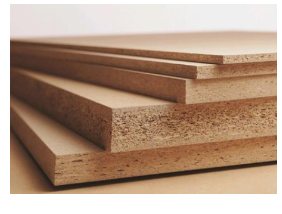
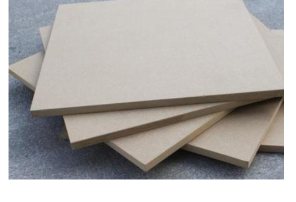
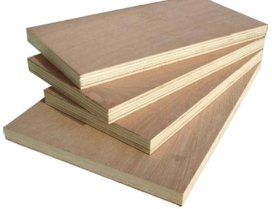
| What it is | Wood chips pressed with resin | Fine wood fibres pressed with resin | Thin wood layers glued cross-grain |
| Holds screws | Well | Poorly | Well |
| Carries load | Well | Poorly | Well |
| Handles moisture | Well, while the edges stay sealed | Poorly | Well, resists warping |
| Can be shaped or routed | No, edges chip when cut | Yes, smooth and easy to shape | Limited |
| Typical thickness and use | 18 mm carcass, 25 mm countertops and exposed sides | 5–9 mm backs, 18–25 mm painted and moulded doors | 18–25 mm premium carcasses and doors |
| Relative cost | Lowest | Low to mid | Highest |
Sheet size for all three: 2,400 × 1,200 mm. Source: factory technical manuals from Oppein, the group behind Oppolia.
Why Singapore humidity is the real test
NEA's Changi records put the daily mean relative humidity at roughly 76–85% over recent decades, and it regularly passes 90% before sunrise. A cabinet here never gets a dry season to recover.
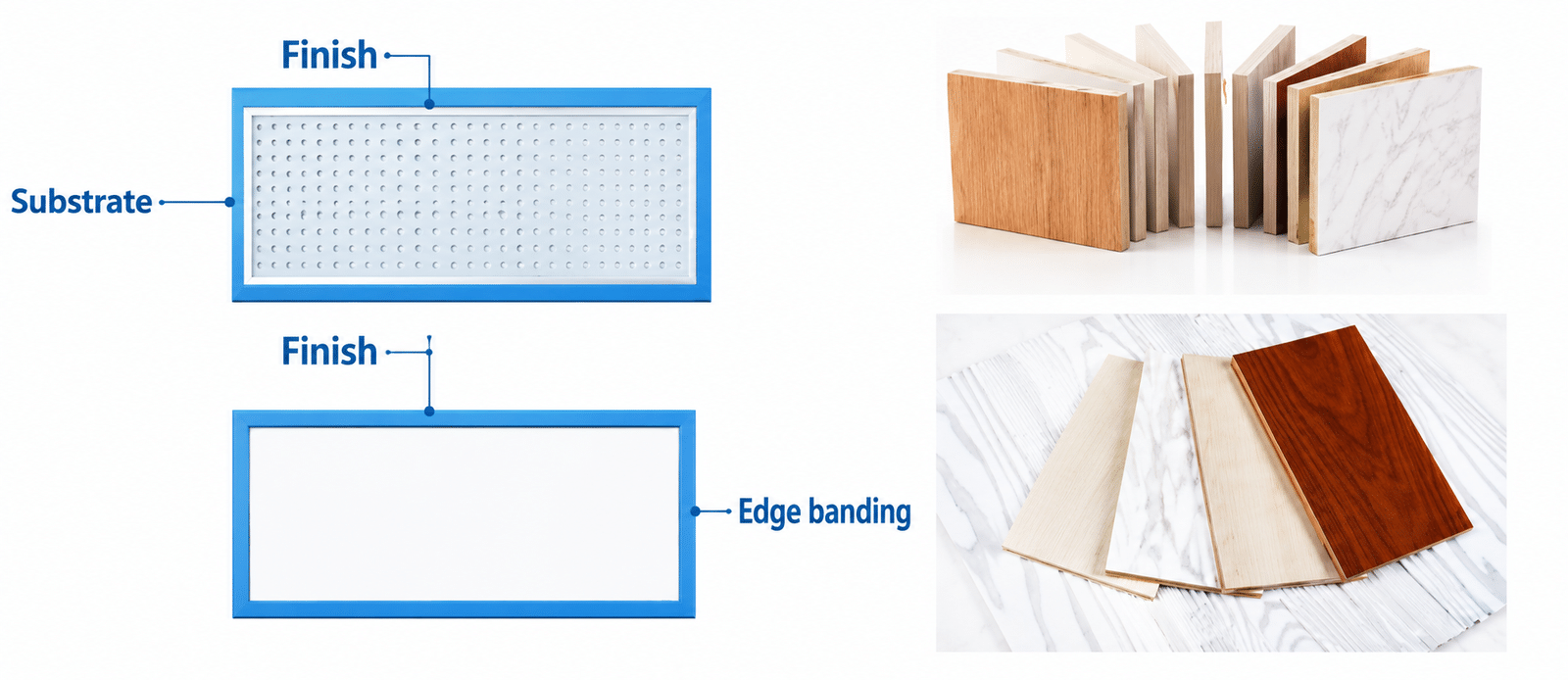
All three boards are wood fibre held together by glue. Each one absorbs moisture if water reaches the raw core. That's why the face of the board matters less than two other things:
- The edges. A cut edge is open core. Edge banding seals it. When banding lifts or was never applied, moisture walks straight in. The factory manual names this as particle board's main risk: if the banding fails, the core swells and blows out. (More in our edge banding guide.)
- Where the cabinet sits. A wardrobe on a dry bedroom wall and a cabinet under a dripping sink live in different climates, even in the same flat.
How each board behaves
Particle board
Most factory-made cabinetry worldwide, including our HausSignature range by Oppolia, uses particle board for the carcass. It is flat, stable, holds screws well and carries shelf loads. Its weak point is the cut edge: chips compress loosely there, so once water gets in, the board swells and won't shrink back.
Where it works: wardrobe carcasses, shelves, kitchen top cabinets, TV consoles. 25 mm versions go where you need extra stiffness, such as countertops, exposed end panels and panels beside a bed.
MDF
MDF has a smooth, fine surface that takes paint and can be routed into shaker and profiled doors. That's why lacquer, powder-coat, thermofoil and veneer doors are built on MDF. It holds screws poorly and sags under load, so it isn't used for long shelves. Thin MDF (5–9 mm) is the usual cabinet back panel.
Where it works: painted and moulded doors, back panels, decorative parts. Keep it away from standing water.
Plywood
Plywood's cross-layered veneers make it strong for its weight, good at holding screws close to the edge and less likely to warp. It also costs the most. In Singapore many homeowners treat plywood as the default "good" board, which is fair for strength, but plywood still swells and delaminates if its edges sit in water.
Where it works: carcasses that carry heavy loads, long spans and premium series. Our HausPole shelves are plywood with a PVC finish.
Want to see the three boards side by side?
Book a showroom visitFormaldehyde: ask for the grade, not the board type
The board type tells you nothing about emissions. The glue does. Ask for the grade by name:
| Grade | Emission limit (GB/T 39600-2021) |
|---|---|
| ENF | ≤ 0.025 mg/m³ (strictest) |
| E0 | ≤ 0.050 mg/m³ |
| E1 | ≤ 0.124 mg/m³ |
Our boards range from E1 to ENF depending on the line and finish you choose, and HausSignature particle boards are described as ENF. Whatever you pick, your quotation names the board grade for every item. Sealed edges also cut emissions, because banding covers the exposed core. (Full explainer: ENF vs E0 vs E1.)
What we see on site
From our installs
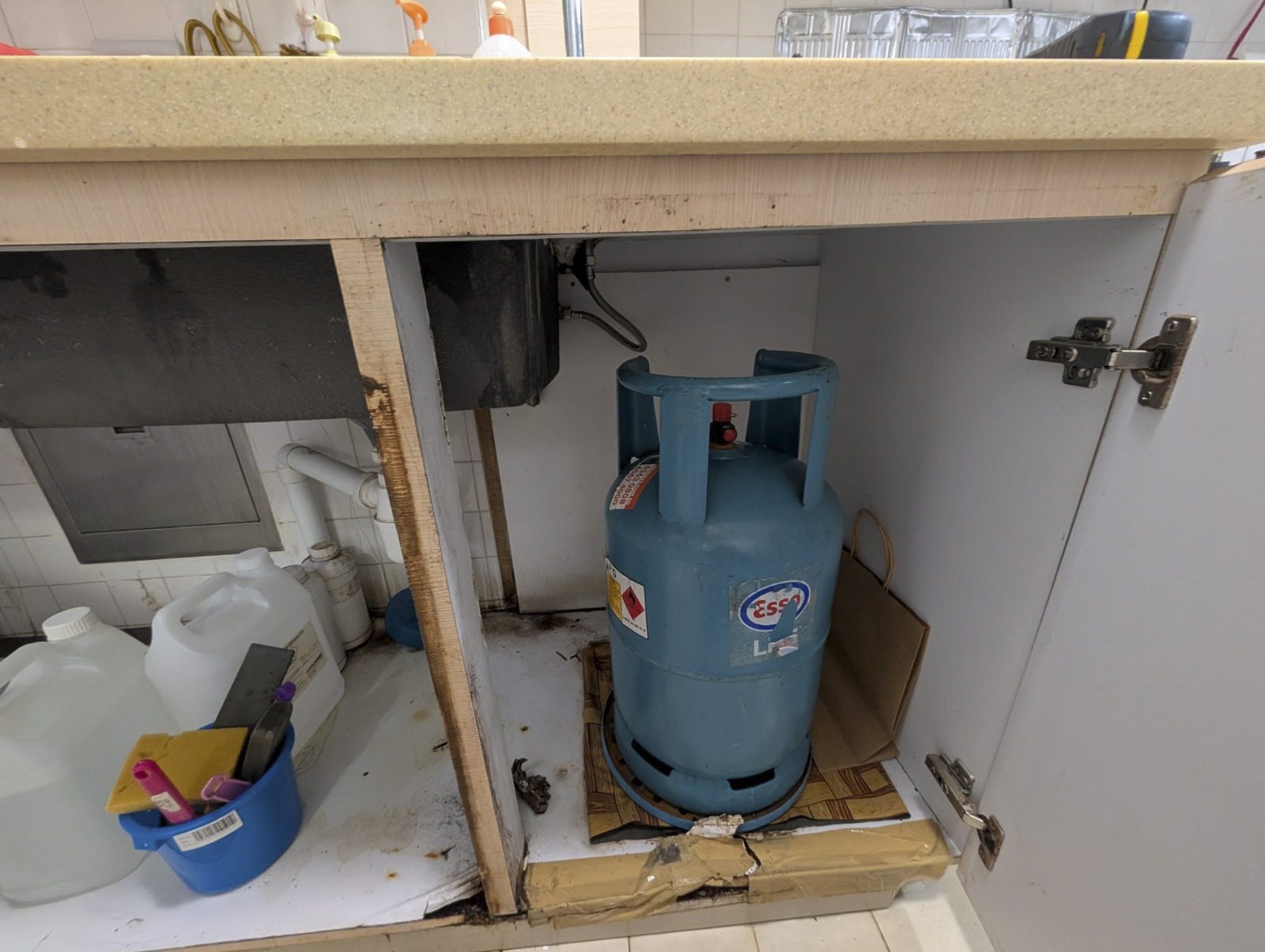
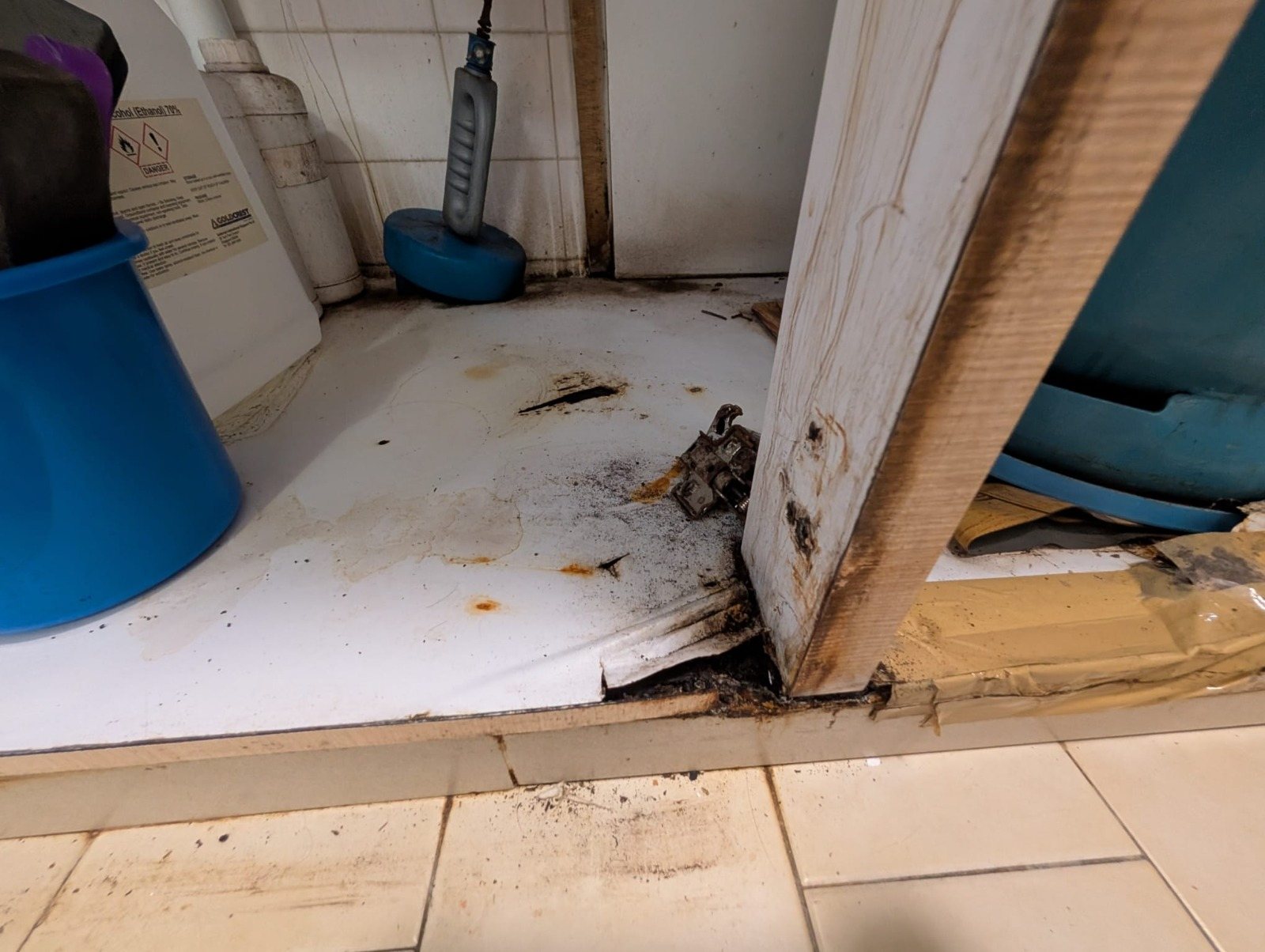
- Bottom panels go first. On older wardrobes we replace, swelling usually starts at the bottom panel and kick board, where mopping water and floor moisture reach unbanded edges.
- Walls shared with a bathroom. In master bedrooms where the wardrobe backs onto an attached bathroom, we've seen back panels and lower side panels swell or grow mould.
- Sink cabinets. The base panel of a wooden sink cabinet is the most common failure we're asked to replace in kitchens. A small leak at the trap sits on the board for weeks before anyone notices. (More in why sink cabinets swell.)
- Shoe cabinets by the main door. Wet shoes and umbrellas swell the bottom shelf if they are not dried before being stored in the cabinet.
For wet zones, skip board altogether
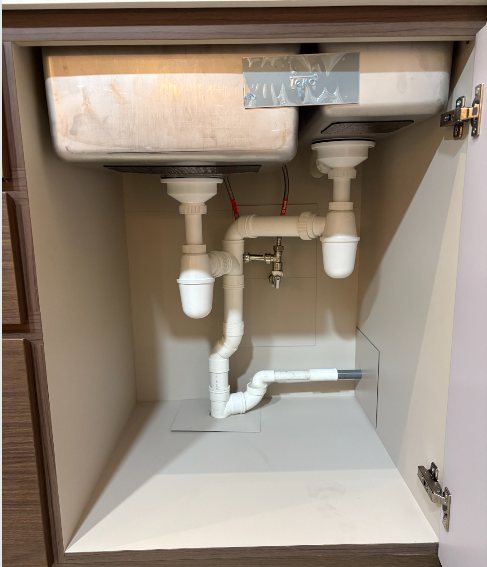
No board grade fixes a cabinet that sits in water. For sinks, bathroom vanities, service yards and outdoor shoe cabinets, we build in aluminium instead.
- HausAluminium carcasses are laser-welded aluminium panels, powder-coated, rated 30 kg per shelf, with a 15–25 year lifespan in wet zones.
- The welded aluminium panels contain no glue, so they release no formaldehyde. WPC doors with laminate are a lower-cost option for the same wet-zone use, but they are not formaldehyde-free.
- If budget is tight, you don't need a full aluminium kitchen. Some homeowners do aluminium only at the sink and keep the rest in wood.
- Cabinets exposed to direct rain and sun are built full aluminium, with welded doors.
Which board where: our rule of thumb
| Location | What we'd use | Why |
|---|---|---|
| Bedroom wardrobe | Particle board or plywood carcass, E0 or ENF, all edges banded | Dry room, needs screw-holding and stiffness |
| Wardrobe against a bathroom wall | Same, with a gap behind the back panel, or HausPole / HausFlex | Less board means less to swell |
| Painted, shaker or curved doors | MDF | Only MDF takes paint and routing cleanly |
| Kitchen top cabinets | Particle board or plywood | Away from standing water |
| Kitchen base and sink cabinets | Aluminium, at least at the sink | Leaks and mopping water |
| Bathroom vanity, service yard, outdoor | Aluminium | Constant moisture |
When board isn't the right answer at all: if you'd rather have no carcass, HausFlex is a steel frame with no board carcass, and HausPole uses aluminium poles with plywood shelves, so there's far less board in the room.
Frequently asked questions
Is plywood better than particle board for a wardrobe?
Plywood is stronger and holds screws better, especially near edges. Particle board is flatter and cheaper. In a dry bedroom with sealed edges, both last. What matters more is the formaldehyde grade and the edge banding.
Is MDF bad for cabinets?
No, it's the right board for painted and moulded doors. It's the wrong board for long shelves or anything that may get wet.
What is moisture-resistant board?
MR boards use resins that slow swelling. They help, but they are moisture-resistant, not waterproof. In a sink cabinet, aluminium is the safer choice.
Can a swollen board be repaired?
Not reliably. Swollen particle board doesn't shrink back. The panel is usually replaced.
How do I know which grade my cabinets are?
Ask for it in writing. Every line on a HausBedroom quotation states the grade.
Free advice
Not sure which board your quote uses?
Not sure which board your quote uses? WhatsApp us the quotation or a photo of your floor plan at +65 6842 1514, or visit our Eunos Technolink showroom (Mon–Sat, 9:30am–6:30pm) to see cut samples of all three boards side by side.