
Short answer
Edge banding is the 0.5–1.5 mm strip glued over a board's cut edge. It keeps humidity out of the core, holds formaldehyde in and stops the edge chipping. Visible edges should get thick banding (around 1.2 mm), hidden edges thin (0.5–0.6 mm). Many cabinet failures in Singapore start at a lifted edge, not the face.
Key facts
| What it covers | The raw cut edge of particle board, MDF or plywood panels |
| Thick banding (visible edges) | 1.2–1.5 mm |
| Thin banding (hidden edges) | 0.5–0.6 mm |
| Round holes | Banded only when 60 mm or larger, on 18/25 mm panels |
| Panels that need none | Lacquer, powder coat, thermofoil, wrapped and aluminium-framed doors |
| Main glues | EVA (common, re-softens with heat) and PUR (cures, doesn't re-melt) |
Thickness and application rules are from Oppolia's factory technical manuals.
Why edge banding matters
The factory manual lists four jobs, and in Singapore all four count:
- Looks. A trimmed, rounded edge feels smooth and finishes the panel.
- Moisture. The cut edge is the most porous part of any board. Banding seals it. With daily humidity averaging around 80% here, an unsealed edge keeps absorbing moisture year-round.
- Formaldehyde. The resin in the board's core gives off formaldehyde. Sealing the edges reduces emissions.
- Lifespan. Banding protects the edge from chipping and keeps the core from swelling.
The six edge banding methods
| Method | How it works | Look | Strength | Where it's used |
|---|---|---|---|---|
| EVA hot-melt | PVC tape bonded with EVA glue | Thin visible glue line | Good in dry rooms; glue can re-soften with heat | Most local carpentry |
| PUR hot-melt | PVC tape bonded with PUR glue that cures by reacting with moisture | Finer glue line | Stronger bond than EVA, doesn't re-melt | Factory cabinetry, kitchens |
| Laser (ABS) | ABS tape with a layer fused by laser or hot air, no separate glue | No visible glue line | Very strong, near-seamless | Premium doors and drawer fronts |
| 45° corner edge | Two panels mitred at 45° so the edge reads as one solid piece | Sculptural, three-dimensional | Depends on the joint | Handle-free designs, feature panels |
| Chamfer edge | Edge cut at an angle | Bevelled | Depends on the glue | Panels meeting at non-standard angles |
| Aluminium strip | 2 mm aluminium profile set into a slot in the edge | Metal line | Helps the panel resist warping | Long or tall panels, aluminium cabinets |
Want to compare edges side by side?
Book a showroom visitThick or thin: which panels get which
Factory rule of thumb: visible faces get thick banding, hidden faces get thin.
- Four thick edges: doors, drawer fronts, countertops, exposed end panels, open-shelf panels you see from both sides, and thickened panels (36, 46, 60 mm).
- Mixed (three thin, one thick): carcass sides, tops, bottoms and shelves where only the front edge shows.
- Four thin edges: back panels, kick boards, filler panels and other hidden parts.
- Holes: on 18 and 25 mm panels, round cut-outs of 60 mm or more (cable holes, vents) get thin banding. Smaller holes aren't banded.
What this means for you: "hidden" isn't always dry. The bottom edge of a sink cabinet or a kick board faces mopping water every week. Ask how those edges are banded.
What we use, and why
- HausPole, HausCarpentry and HausAluminium WPC doors: EVA edge banding. In a dry bedroom, a well-applied EVA edge performs well, and it keeps local work affordable.
- HausAluminium welded panels: an aluminium buckle strip. No glue at all.
- HausSignature by Oppolia: PUR edge banding, machine-applied on HOMAG equipment, with Rehau tape on melamine and PET doors.
Where PUR earns its cost: near heat and moisture, such as next to the hob, the dishwasher and the sink.
How to spot bad edge banding: a 2-minute check
You can do this in any showroom, or on a cabinet at handover.
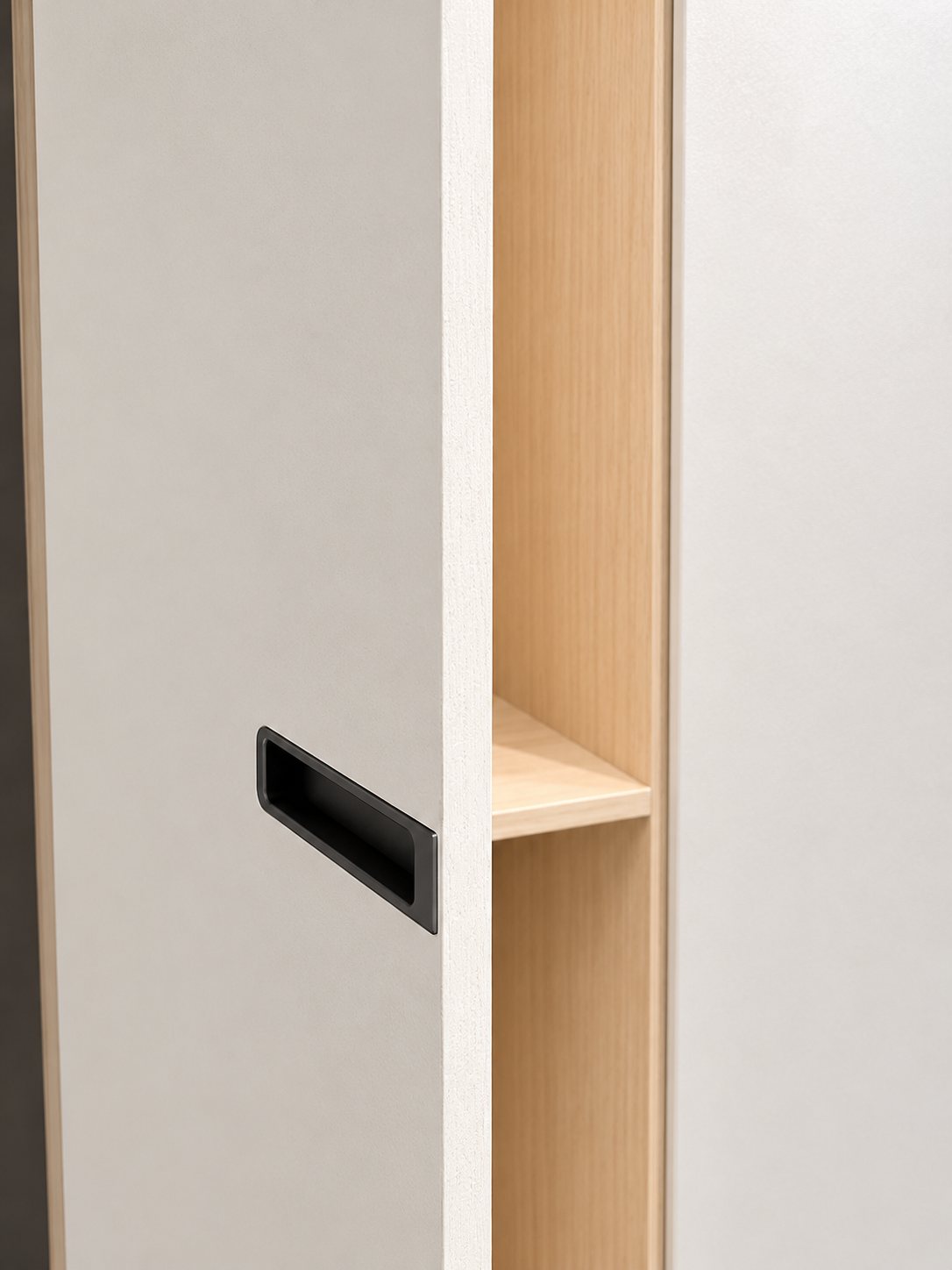
- Run a fingertip along the edge. It should feel smooth and slightly rounded. A sharp lip or a ridge means poor trimming.
- Look for the glue line. A thin, even line is normal for EVA. A thick, dark or uneven line means too much glue or too little pressure.
- Check the corners and ends. Gaps, lifted tips or tape that stops short of the corner are where moisture gets in first.
- Look under the tape. Chipped board showing beneath the banding (the factory manual calls this micro-chipping) means the edge won't seal properly.
- Press along long edges. Any bubble, wave or soft spot means the tape isn't bonded there.
- Open the doors and look down. Check the bottom edges of the carcass and the kick board. Unbanded raw board at floor level is a warning sign.
- Check cut-outs. Large cable holes and sink cut-outs should be sealed.
What failure looks like
| Stage | What you see | What it means |
|---|---|---|
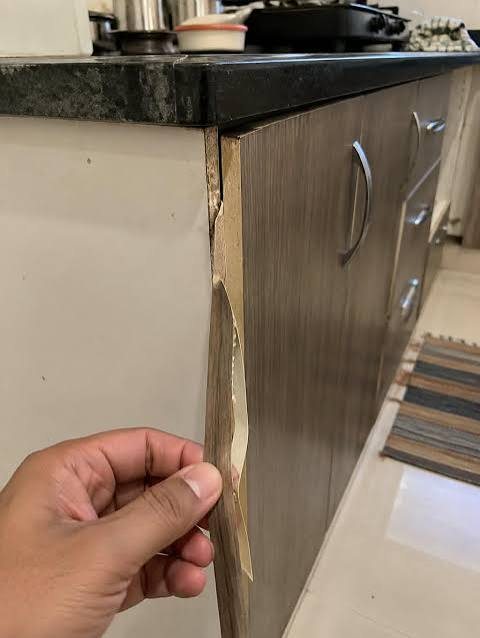
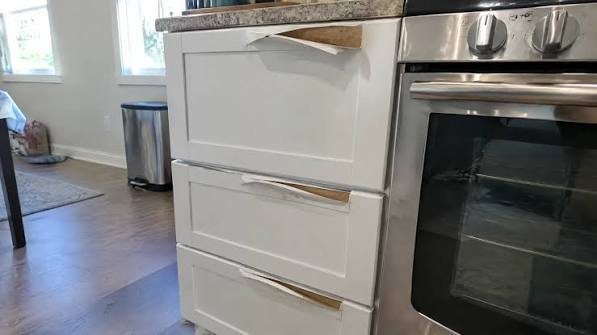
| Early | A corner lifts, a hairline gap opens along the edge | Glue has let go; still fixable |
| Middle | The edge feels soft or puffy, the tape bulges | Moisture is in the core |
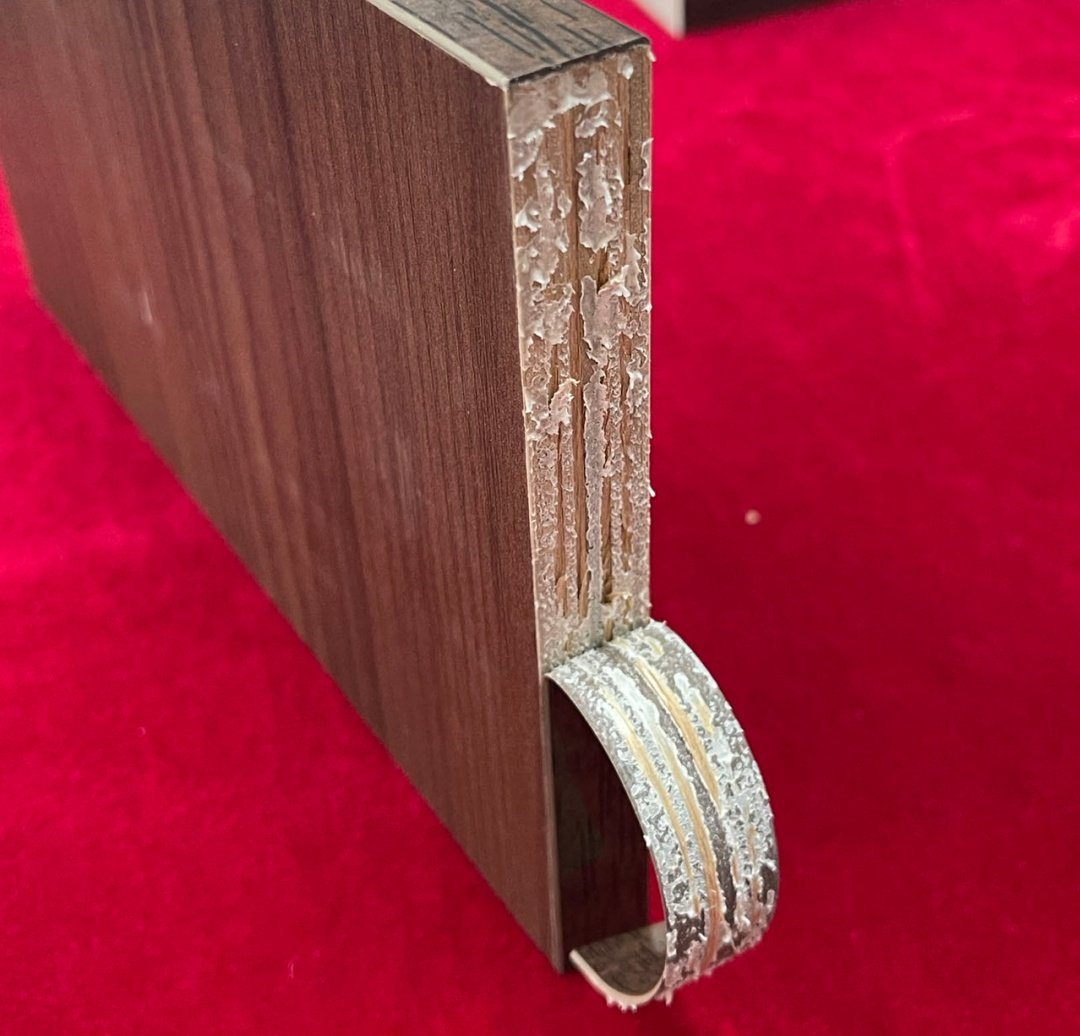
| Late | The board swells and crumbles, laminate cracks, a dark mould line | The panel needs replacing |
Common places we see it: door edges beside the oven or dishwasher, the base of sink cabinets, bottom panels of wardrobes on bathroom walls and shoe cabinets by the main door.
Caught early, a lifting edge can be re-glued or re-banded. Once the board swells, it doesn't shrink back.
Questions to ask your contractor
- Which glue do you use: EVA, PUR or laser?
- How thick is the banding on doors and visible edges?
- Are all four edges of every door banded thick?
- Are the hidden edges at floor level and under the sink banded?
- Is the banding machine-applied in a workshop or factory, or ironed on at site?
Frequently asked questions
Why is the edge of my cabinet peeling?
Usually heat or moisture has softened the glue, or the edge wasn't pressed properly when it was banded. Edges beside the hob, oven and sink fail first.
Is PUR edge banding better than EVA?
PUR bonds more strongly and doesn't re-melt with heat, so it lasts longer in kitchens. In a dry bedroom wardrobe, a well-applied EVA edge does the job.
Can peeling edge banding be fixed?
Yes, if the board underneath is still sound. If the core has already swollen, the panel needs replacing.
Do lacquer and thermofoil doors have edge banding?
No. Lacquer and powder coat are coated over the edges, and thermofoil film wraps them.
What thickness should edge banding be?
About 1.2 mm on edges you see and touch, 0.5–0.6 mm on hidden edges.
Free advice
Got a quote and not sure what edge banding it uses?
Got a quote and not sure what edge banding it uses? WhatsApp it to us at +65 6842 1514 and we'll tell you what to ask. Or bring a sample to our Eunos Technolink showroom (Mon–Sat, 9:30am–6:30pm) and compare edges side by side.