
Short answer
Sliding doors need no swing space, which is why they suit HDB bedrooms where the bed sits close to the wardrobe. The trade-off: with two doors, you can only open about half the wardrobe at a time. Plan four things before ordering: what sits behind the overlap, how the top track is fixed, how runs over about 1.8 m are split, and how the base handles uneven floors.
Key facts
| Sliding | Swing (casement) | Bifold | |
|---|---|---|---|
| Space in front | None | About one door width (up to 600 mm) | About half a door width |
| Access at once | About half the wardrobe | All of it | Nearly all of it |
| Internal drawers | Must clear the door frames and overlap | Need wide-angle hinges | Must clear the folded doors |
| Best for | Small rooms, long runs, mirror doors | Rooms with clearance, full access | Walk-ins and corners where you want wide access |
Planning point 1: the overlap
Sliding doors run on two tracks and stack over each other when open. Wherever the doors overlap, you can only reach in from one side. Two rules follow:
- Put long hanging, not drawers, behind the overlap. A drawer that sits half behind a closed door can't open fully.
- Check drawer fronts clear the door frames. Aluminium-frame doors have a frame on each edge. Drawers need to pull out past it with either door open.
Factory design rules add one more: don't put drawers under a shelf that has no side panel supporting it. The shelf sags under load and the drawer jams.
Planning point 2: the top track
The top track carries most of the door's guidance, so it needs a straight, solid fixing.
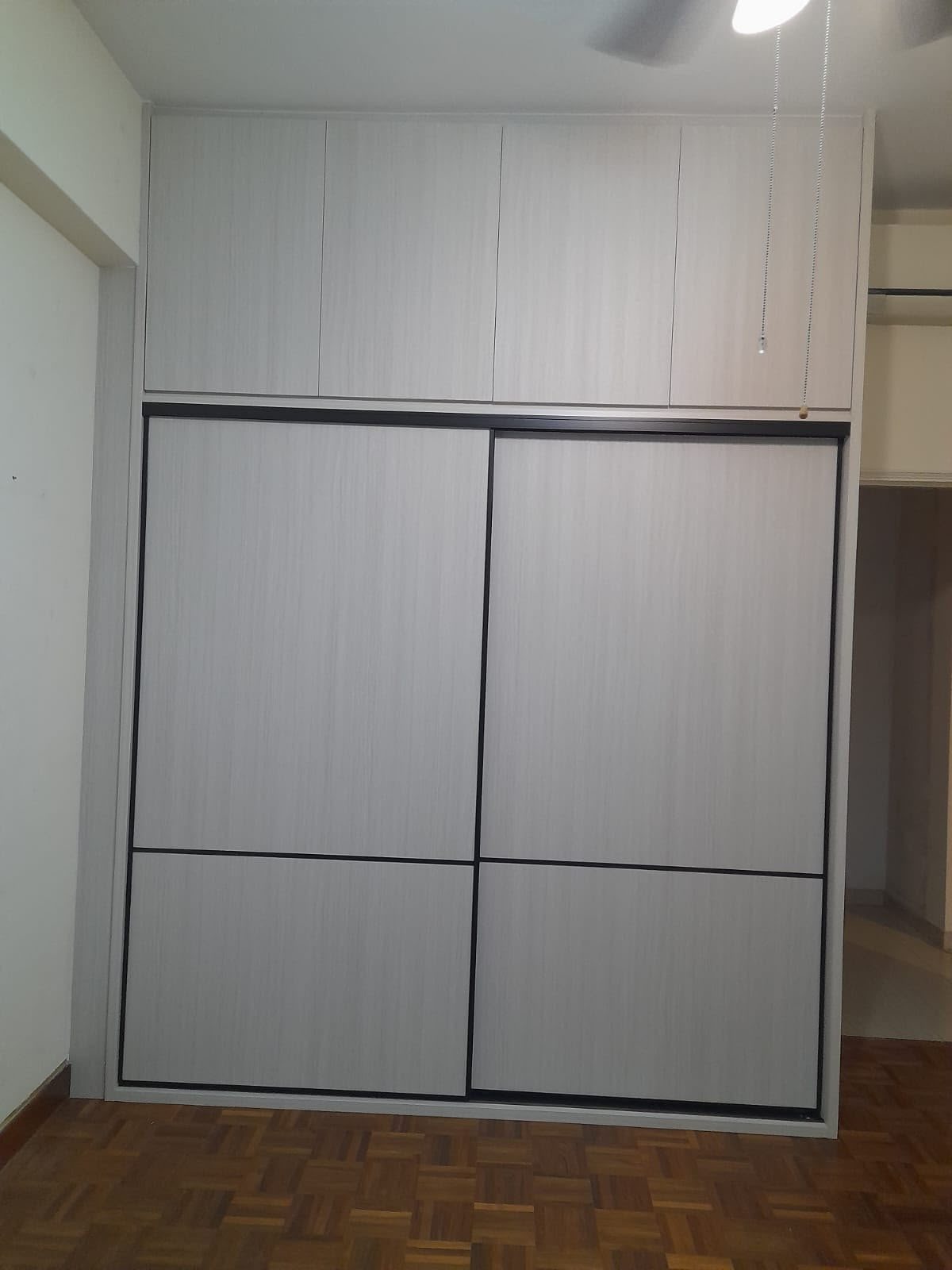
- With a top cabinet, the track can fix straight to the cabinet's underside.
- Without one, a filler board or pelmet carries the track up to the ceiling.
- Beams: where a beam drops into the run, the wardrobe is notched around it. The factory rule is to cut the notch 20 mm larger than the beam.
On HausPole, the standard built-in package includes the slim-line aluminium sliding doors plus a partition wall and pelmet up to the ceiling, and the aircon trunking and power points stay serviceable.
Want to try sliding, swing and bifold doors?
Book a showroom visitPlanning point 3: long runs
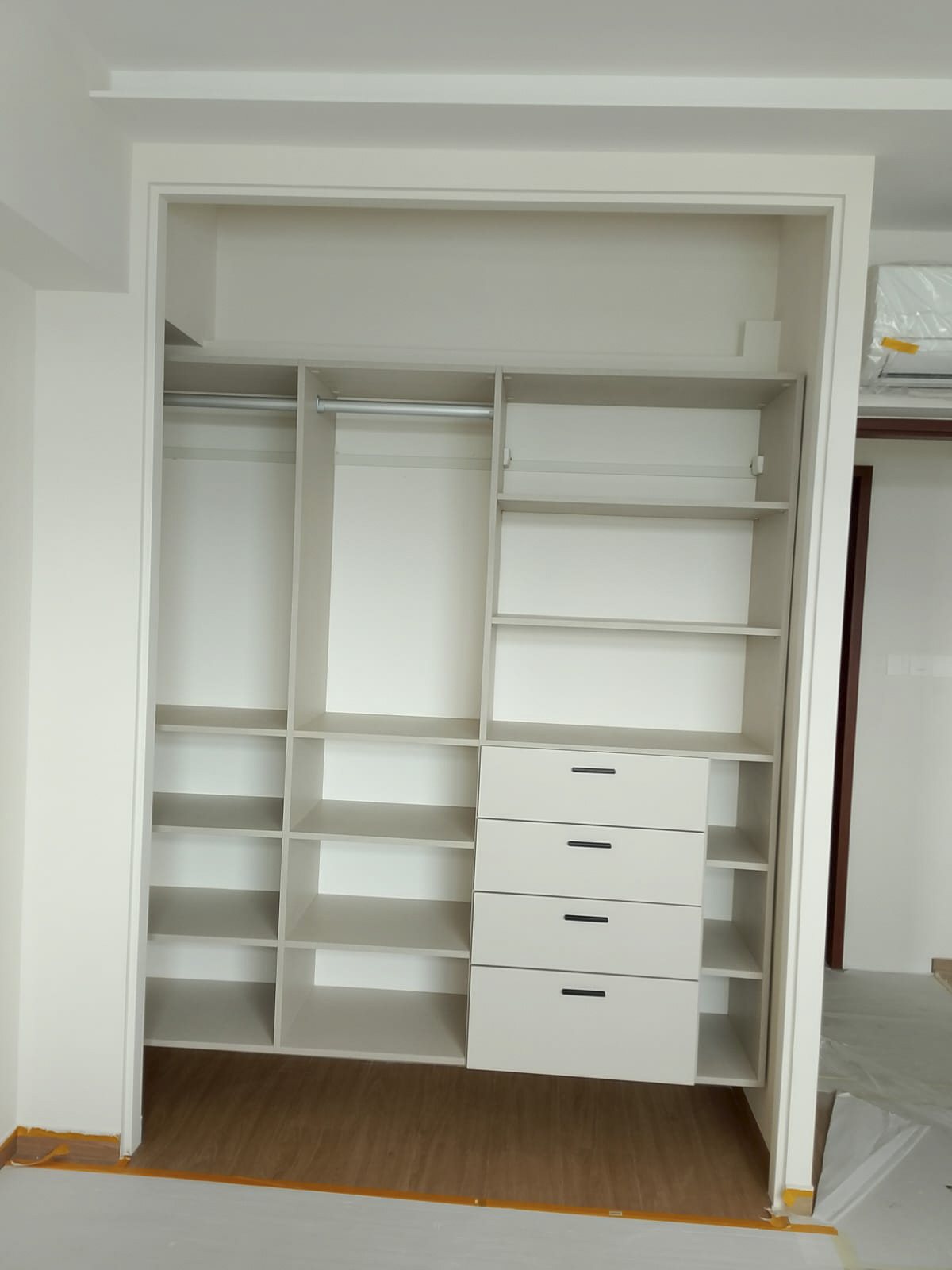
Factory rules split the internal cabinet once a sliding wardrobe goes past about 1.8 m, so it can be carried in and installed. Inside long or tall sections:
- A full-height hanging section gets a fixed middle shelf to stop the side panels bowing.
- The outer end section uses fixed shelves no more than 1,440 mm apart, or a thicker 25 mm end panel.
This is where modular systems help. HausPole and HausFlex are built in sections on site, so long runs and odd lengths are straightforward.
Planning point 4: the base
The bottom track needs a level line. HDB floors are rarely perfectly level, and platforms change the height.
- On a raised platform or tatami, the factory rule replaces the filler board with a base box about 100 mm high, or the platform height plus 100 mm when the wardrobe stands on the floor beside it.
- On uneven floors, the base is levelled before the doors go on.
Door options across HausBedroom lines
| Line | Sliding door options |
|---|---|
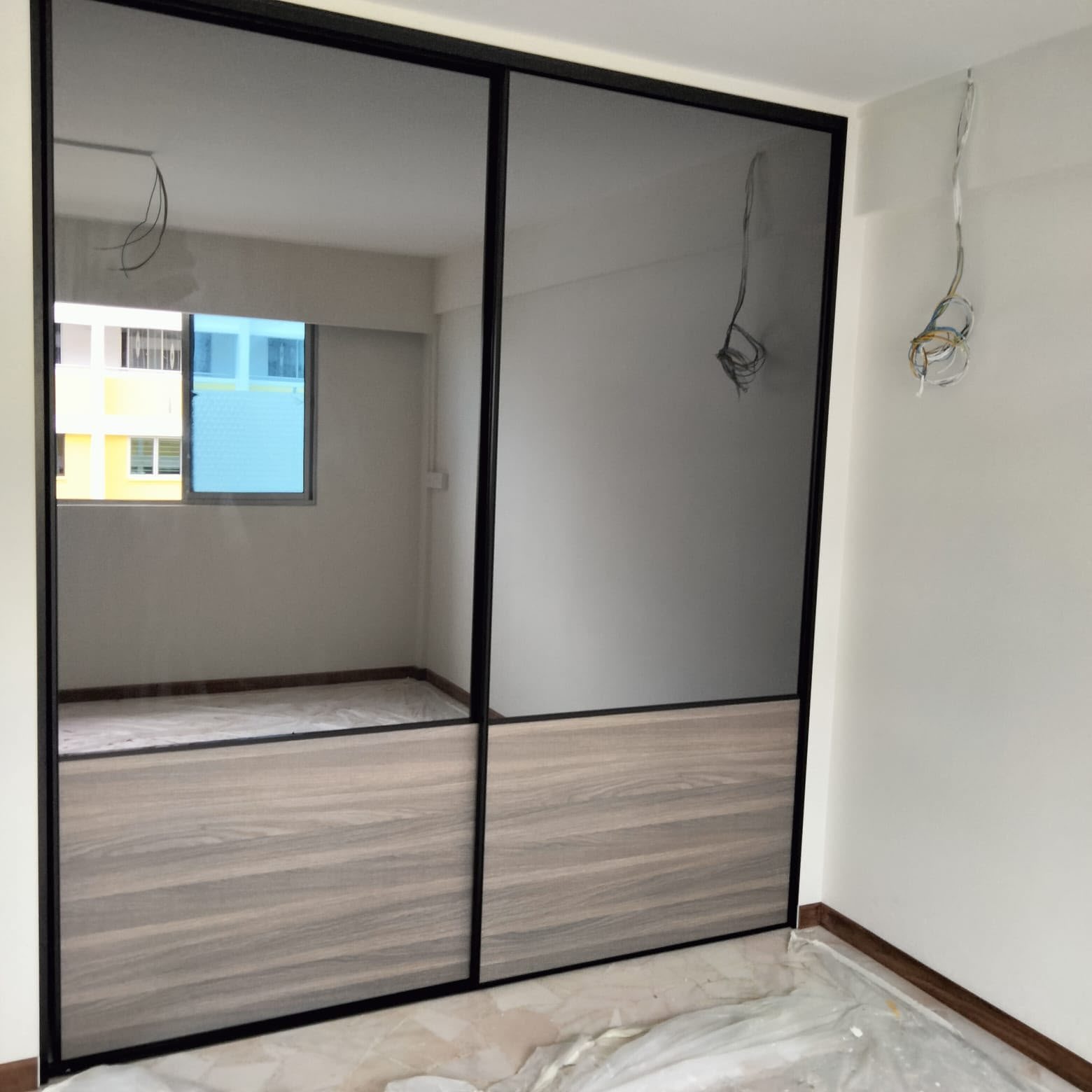
| HausPole | Slim-line aluminium-frame sliding doors with glass; bifold also available |
| HausFlex | Sliding, bifold or HausGlide; frames in white or black |
| Custom built-in | We use the same slim-line aluminium sliding door. |
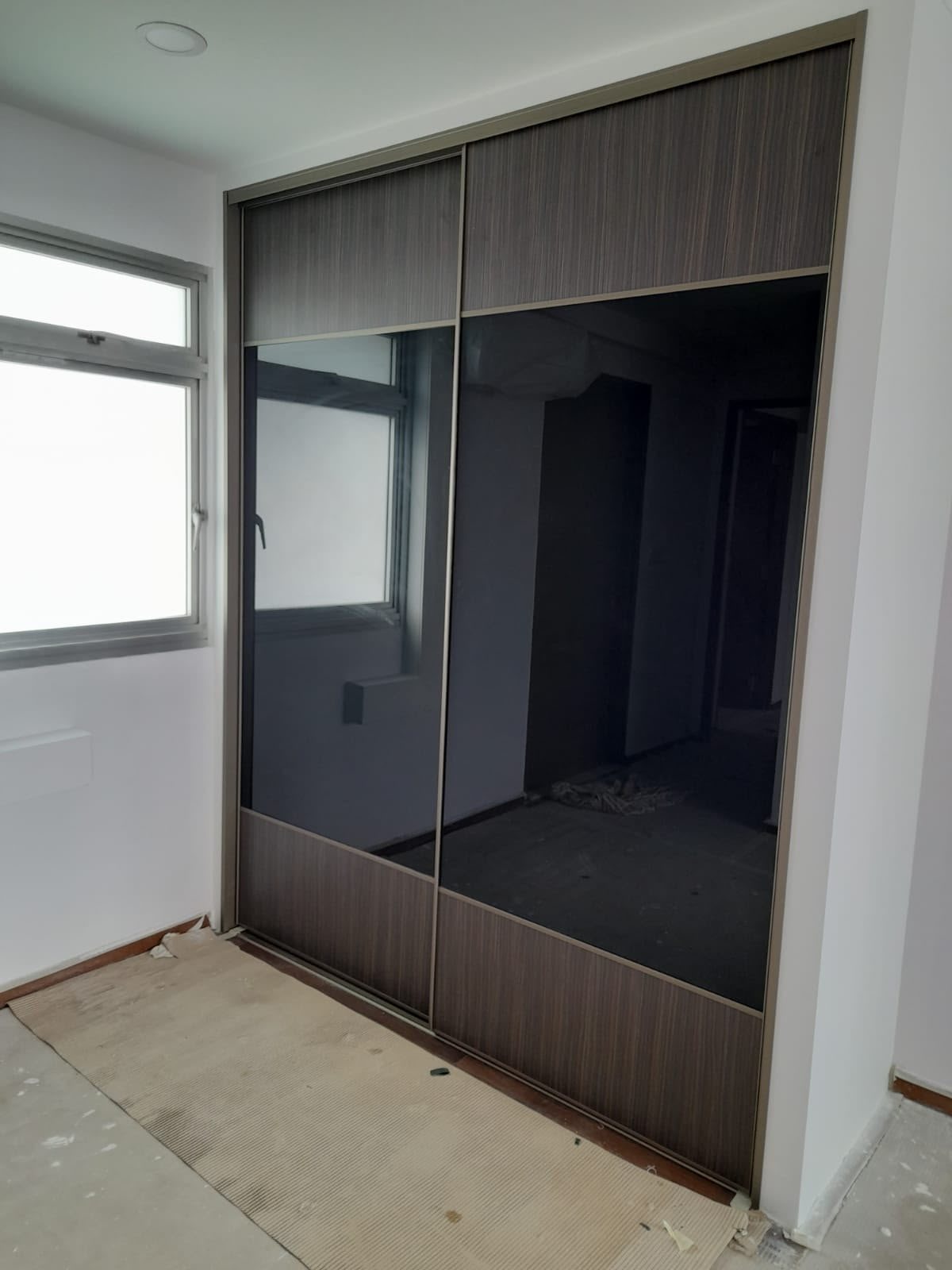
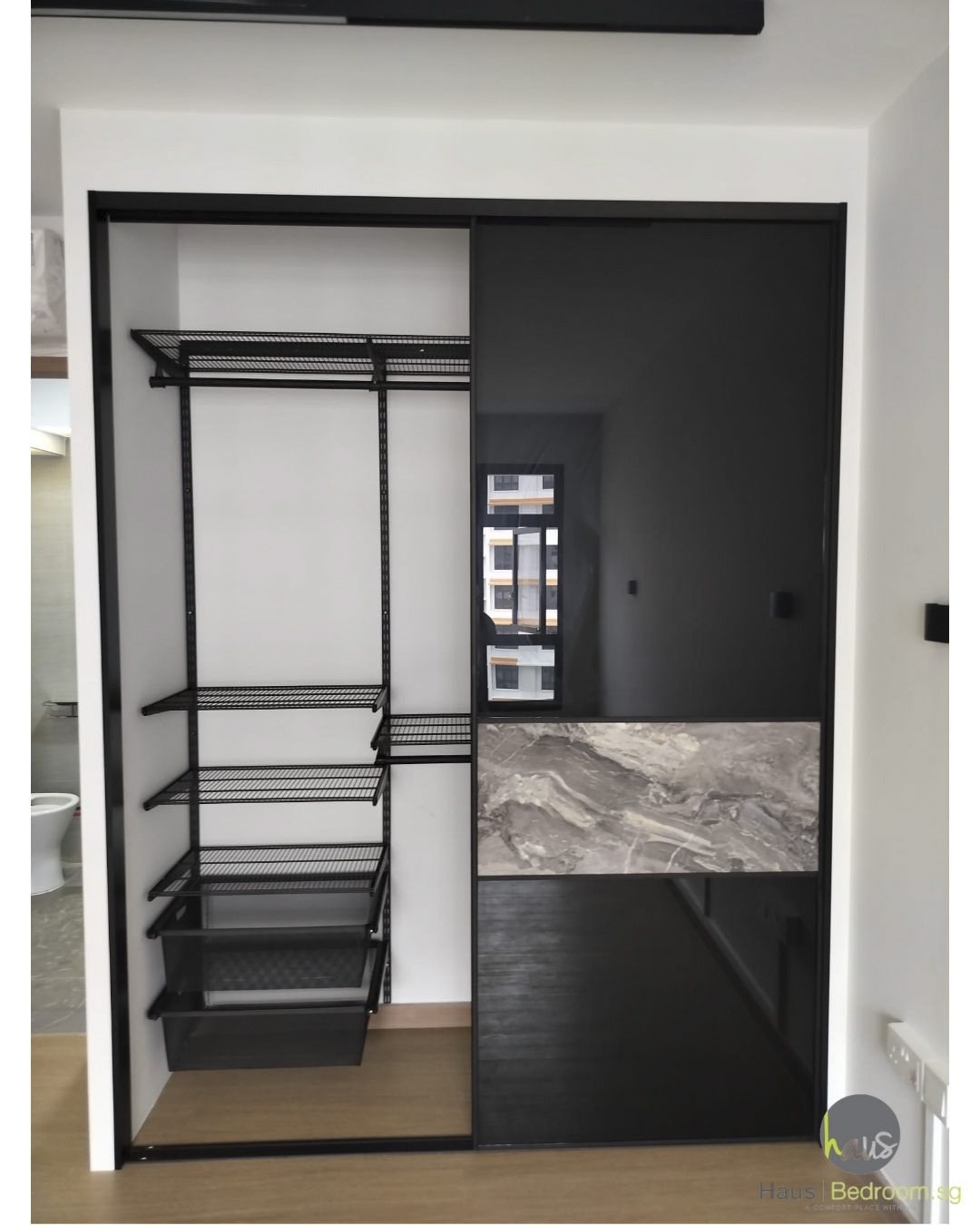
Glass and mirror finishes (5 mm glass, normal or tempered): frosted, tinted grey, black or brown, opaque, clear mirror, grey or tea mirror, and fluted. A full-length mirror door saves wall space in a small bedroom.
HausGlide is a folding-sliding door, in a wooden frame only.
Caring for sliding doors
- Vacuum the bottom track every few weeks. Hair and dust are the main cause of rough sliding.
- Don't force a door that drags. The rollers usually just need adjusting.
- Wipe glass and mirror with a soft cloth. Avoid ammonia cleaners on mirror backs and film.
Sliding, swing or bifold?
| Your room | Our suggestion |
|---|---|
| Bed or desk within about 60 cm of the wardrobe | Sliding |
| You want to see the whole wardrobe at once | Swing, if there's clearance, or bifold |
| Long wall, 2.4 m or more | Sliding, three or more panels |
| Walk-in or study converted to a walk-in | Usually open (no doors), or bifold at the entrance |
| Small room needing a full-length mirror | Mirror sliding doors |
| Wardrobe on a raised platform | Sliding with a base box |
Frequently asked questions
Are sliding wardrobe doors better than swing doors?
In small rooms, usually yes, because they need no clearance. Swing doors give full access at once and suit rooms with space in front.
Can I put drawers behind sliding doors?
Yes, as long as they sit away from the overlap and clear the door frames when either door is open.
Why do sliding doors get hard to move?
Most often dust and hair in the bottom track, or rollers that need adjusting.
Can sliding doors go up to the ceiling?
Yes. The top track fixes to a top cabinet or to a pelmet up to the ceiling. On HausPole, trunking stays serviceable.
Can I have a mirror on a sliding door?
Yes. Clear, grey and tea mirror are all options on our glass doors.
Free advice
Sliding, swing or bifold?
Send us a photo of your room and its rough measurements on WhatsApp at +65 6842 1514, and we'll tell you whether sliding, swing or bifold suits it. Or try all three at our Eunos Technolink showroom (Mon–Sat, 9:30am–6:30pm).